what does it mean for a function tf(x) between a and b to be normalized
Probability density function | |
| A probability density part:
The post-obit topics are discussed:
| |
Products Abaqus/Explicit Abaqus/Viewer
Introduction
There are many examples of randomness associated with data. Particle sizes in a granular media such every bit gravel are an case. Randomness observed in data can be described by statistical distributions. Pseudo-random numbers that are generated based on statistical distributions are used to capture randomness in data in a numerical simulation.

Applications
The size distribution of particle species generated by a particle generator can be described by statistical distributions.
Probability density part
A probability density office (PDF) describes the probability of the value of a continuous random variable falling within a range. If the random variable can only accept specific values (like throwing die), a probability mass function (PMF) would be used to depict the probabilities of the outcomes. The plot on the left in Figure 1 shows a PDF for the random variable . The probability that the random variable has a value in the range and is . The probability that the random variable will be in the range is given by:
The probability that the random variable is in the range and is 1; i.e.,
The area under the PDF curve is, therefore, always unity.
Figure one. Probability distributions of continuous and discrete variables.
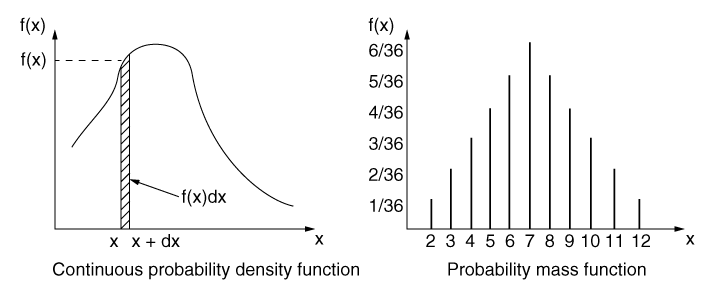
The plot on the right in Effigy one shows a PMF where the horizontal axis shows the specific values of the random variable and the vertical centrality shows the corresponding probabilities.
Abaqus/Explicit supports compatible, normal (Gaussian), log-normal, piecewise linear, and discrete probability density functions. To define a probability density function, you must assign information technology a name and specify its type.
Uniform probability density function
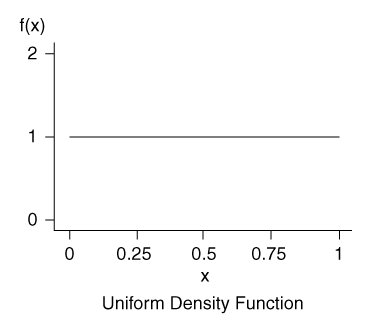
Uniform distributions (shown in Figure two) have many applications, particularly in the numerical simulation of random processes. The following function describes a uniform probability density role for a random variable between and :
The mean is and the variance is . You specify and for the compatible distribution.
Figure 2. Uniform PDF.
Normal probability density part
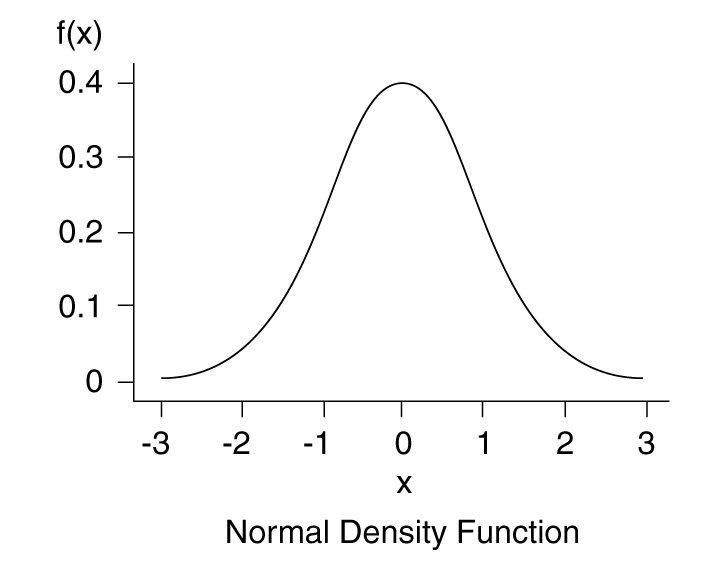
Normal distributions (shown in Effigy three) have many applications in science and engineering; for example, errors in experimental measurements are often causeless to take a normal distribution. The following function describes a normal probability density function:
The mean is , and the variance is . Y'all specify the mean, , and standard deviation, , for the normal distribution.
Figure three. Normal PDF.
Log-normal probability density office
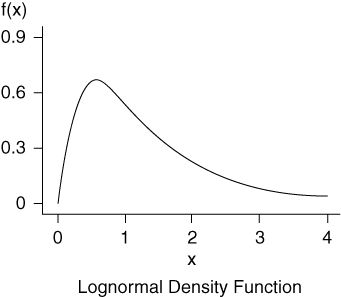
Log-normal distributions (shown in Figure 4) are used in describing many natural phenomena. They are commonly used to draw particle size distributions in soils. The following function describes a log-normal probability density function:
The mean, , and standard divergence, , in the space are related to and as follows:
where the parameters and are the mean and standard deviation in the space; given by and respectively. Y'all specify the mean, , and the standard deviation, , in the infinite for the log-normal distribution.
Effigy 4. Log-normal PDF.
Piecewise linear probability density function
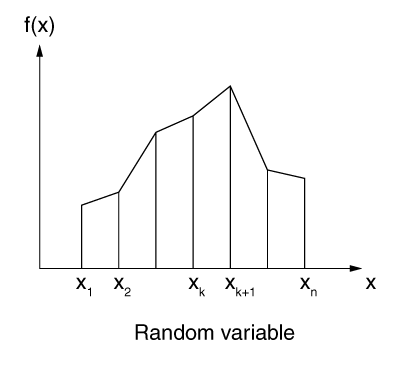
A piecewise linear probability density office can be used to approximate general distributions that are not well represented by the other PDF forms discussed above. With a piecewise linear probability density function, y'all specify PDF values at discrete points. Abaqus/Explicit considers linear variations in the PDF between these points, as shown in Figure 5. The PDF is zero below the starting time data point and above the last data point.
Effigy 5. Piecewise linear PDF.
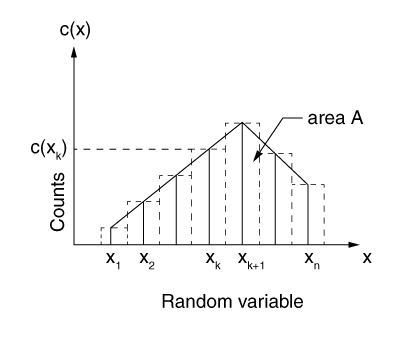
As mentioned earlier, the area under a PDF is unity. Abaqus/Explicit volition renormalize the specified PDF information to accomplish this requirement. This renormalization of data values allows you to specify relative PDF values that may exist obtained from a histogram. A histogram contains the data in the form of a table of random variable ranges and the percentage or number that autumn within those ranges. Equally shown in Figure 6, yous specify a table of the midpoint value of each range in the histogram and the respective count:
As mentioned above, Abaqus/Explicit will renomalize these data to create the piecewise linear probability density function.
Figure 6. Histogram.
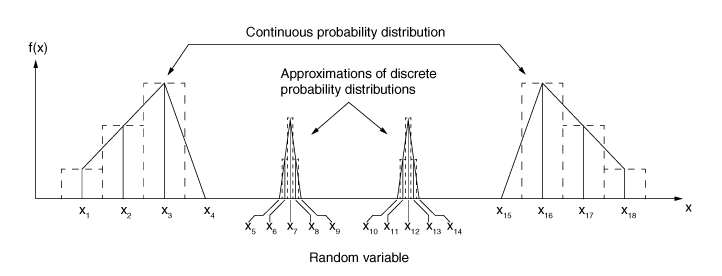
At that place may be situations where the random variable has continuous values over certain ranges and discrete values elsewhere. Effigy 7 shows the utilize of a piecewise linear probability density function to judge such distributions where the detached values are approximated by continuous random variables spanning a very narrow range of values (for example, the discrete value is approximated past the continuous range from to ).
Figure 7. Approximating a discrete probability distribution using a piecewise linear PDF.
Discrete probability density function
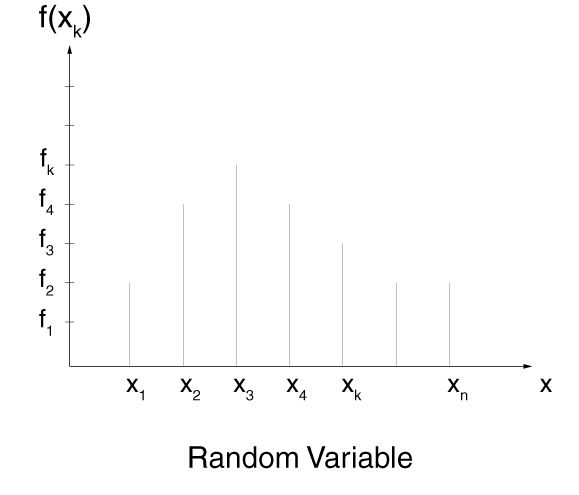
Some applications take only sure specific outcomes. These applications can be represented by a discrete probability density function, as shown in Figure 8. A simple example is throwing of a pair of dice. Merely the outcomes of ii, 3, iv, 5, vi, vii, 8, 9, 10, xi, and 12 are possible, with the probabilities of ane/36, two/36, iii/36, 4/36, five/36, 6/36, 5/36, 4/36, three/36, 2/36, and 1/36, respectively. A very specific case of a detached probability density function is the case when only one value occurs with the probability of one. To specify a discrete probability density office, yous provide a table of the specific values of the random variable along with the corresponding probability:
Abaqus/Explicit will renormalize the specified probabilities to ensure that they sum up to ane.
Figure viii. Discrete PDF.
Truncated probability density function
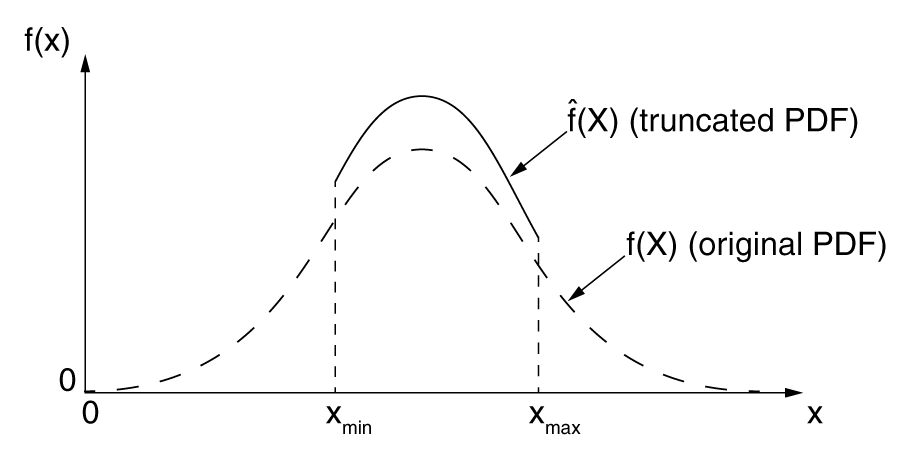
The normal and log-normal probability density functions take open up-ended characteristics. These PDFs tin exist truncated to enforce upper and lower bounds on the value of the random variable. Figure 9 shows a truncated normal distribution where all values of the random variable and from the untruncated normal distribution take been rejected.
where
The factor represents the probability that the random variable is in the range from to for the untruncated PDF.
Figure 9. Truncated PDF.
You specify the lower and upper limits of the random variable along with the mean and standard deviation for these types of PDFs. The uniform and the piecewise linear distributions have lower and upper limits for the random variable built into the definition of the PDF and, therefore, do non require renormalization because of truncation.
Output
No output is available for probability density functions.
Limitations
Probability density functions are supported simply for the size distributions of PD3D elements created using a particle generator.
Input file template
The following example illustrates the utilise of a probability density function for particle size distribution:
HEADING … PARTICLE GENERATOR, Name=generator_name, Blazon=PD3D, MAXIMUM NUMBER OF PARTICLES=number ** PARTICLE GENERATOR INLET, SURFACE=inlet_surf ** PARTICLE GENERATOR MIXTURE gen_SET1, gen_SET2 ** PROBABILITY DENSITY FUNCTION, NAME=PDF_gen_SET1, TYPE=NORMAL Data line to define PDF PROBABILITY DENSITY Role, NAME=PDF_gen_SET2, Blazon=LOGNORMAL Information line to define PDF ** DISCRETE SECTION, ELSET=gen_SET1 PDF_gen_SET1 DISCRETE SECTION, ELSET=gen_SET2 PDF_gen_SET2 … Stop Footstep
References
- "Probability, Statistics, and Decision for Ceremonious Engineers," McGraw-Colina , 1970.
- "Numerical Recipes in Fortran 77, The Art of Scientific Computing," University of Cambridge , 1992.
- "Calculator Generation of Statistical Distributions," Regular army Research Laboratory , 2000.
Source: https://abaqus-docs.mit.edu/2017/English/SIMACAEMODRefMap/simamod-c-probdensityfunc.htm
0 Response to "what does it mean for a function tf(x) between a and b to be normalized"
Post a Comment