whats it like to be in the 101st airborne
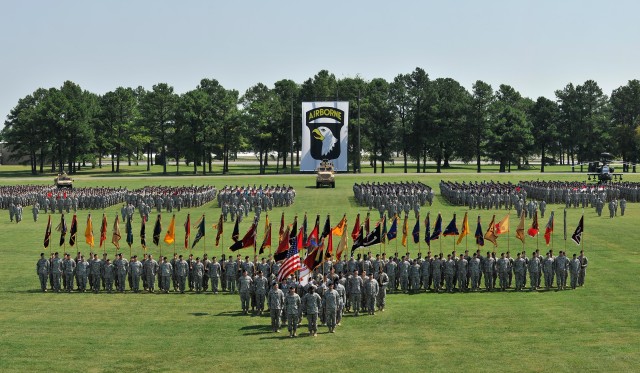
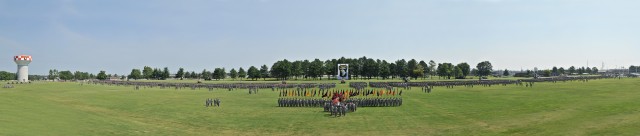
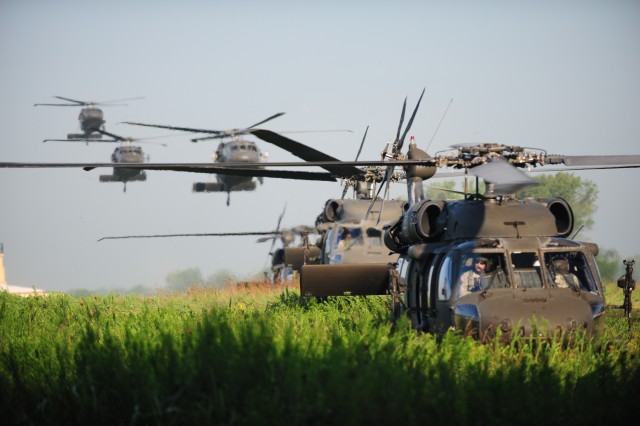
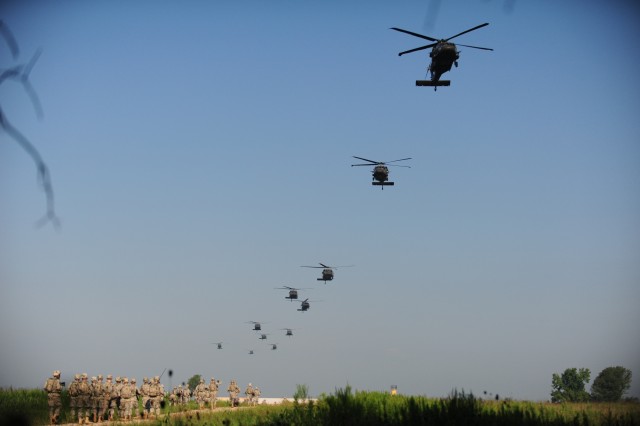
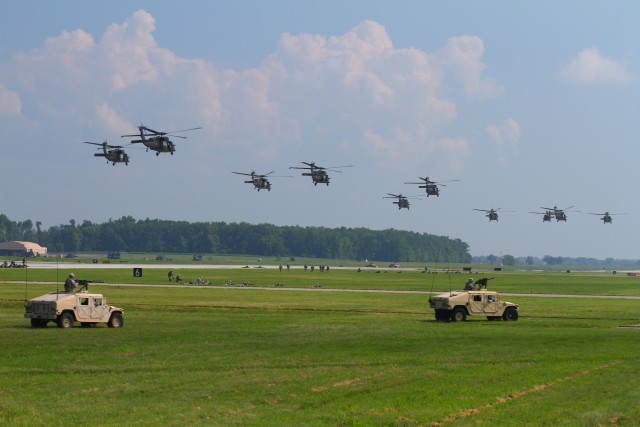
The Screaming Eagles are one of the most deployed and recognized Divisions in the U.Due south. Army, with a combat tape spanning from the paratroopers of World State of war II to the Security Force Assistance Teams deployed in Transitional islamic state of afghanistan today.
The 101st Airborne Division was activated August sixteen, 1942 at Camp Claiborne, Louisiana. Its first Commanding General, Major General William C. Lee, noted that the Partition had no history, but that it had a "rendezvous with destiny" and that the new Sectionalization would be habitually called into action when the need was 'immediate and extreme". Throughout its 70-year history, the Sectionalisation has clustered a proud record, in both war and peace, unmatched by any other unit.
Post-obit its activation and initial training in the U.s.a., the Partitioning embarked for the European Theater of Operations in September, 1943 where it continuing its training in England. During the early morning hours of June 6th, 1944, the Screaming Eagles parachuted into the Contentin Peninsula becoming the kickoff Allied Soldiers to fix human foot onto occupied French republic. The 101st Airborne Division, charged with immigration the manner for the 4th Infantry Division'due south landing on Utah Embankment, eventually linked the Utah and Omaha beachheads and liberated the city of Carentan. Later a month of fighting, the Division returned to England to prepare for futurity operations.
On Sept. 17, 1944, the Sectionalization jumped into Holland spearheading Operation Market Garden. Holding a narrow xvi-mile corridor through enemy-held territory, the Division fought against heavy odds for 72 days. In belatedly-Nov, 1944, the Sectionalization returned to French republic for a well-deserved residual. The balance would be a brusque one.
To counteract the massive German offensive through the Ardennes Forest in mid-December 1944, the 101st Airborne Division was unexpectedly recalled to the front. Responsible for defending the disquisitional road junction at Bastogne, Belgium, the 101st Airborne Partition was surrounded by strong enemy forces that demanded its immediate surrender. Responding to the German language ultimatum, Brigadier Anthony C. McAuliffe made history with his famous one-discussion reply ... "Nuts!" Although the siege of Bastogne was cleaved on Dec 26th, 1944, intense fighting continued until mid-January, 1945 equally Allied units reduces Nazi gains in the Ardennes salient.
Attacking the heart of Deutschland through the Ruhr valley, the 101st Airborne Sectionalisation pursued retreating German forces into Bavaria. In spring 1945, the Screaming Eagles liberated the Landsberg concentration camp and Hitler's mountaintop retreat in Bertchtesgaden. The end of Earth War Two in Europe relegated the 101st Airborne to occupation duties in Germany, Austria, and France. The Division was inactivated on November 30th, 1945.
The immediate post-war period marked an intermittent beingness for the Screaming Eagles. The period is marked by several reactivations and inactivations at Military camp Breckinridge, Kentucky and Fort Jackson, South Carolina. Official reactivation ceremonies, held on September 21, 1956, marked the 101st Airborne Division's return to agile duty as the Army's starting time nuclear capable, Pentomic Division and its debut at Fort Campbell, Kentucky.
In September 1957, elements of the 101st Airborne Division were ordered to Little Stone, Arkansas by President Eisenhower. As part of Operation Arkansas, the 1st Airborne Battle Group, 327th Infantry escorted the offset nine African-American students--the "Little Stone Nine"--as they attended classes at Little Rock Central High School. Successful, the Bastogne Bulldogs returned to Fort Campbell in late-1957.
On July 29th, 1965, the 1st Brigade, 101st Airborne Division was ordered to the Commonwealth of Vietnam earning the nick-name of "The Nomads of Vietnam". The remainder of the Division remained at Fort Campbell until ordered to Vietnam in late-1967. During the enemy's ill-blighted Tet Offensive in 1968, the Screaming Eagles were involved in combat operations from Saigon to Quang Tri Province.
In August 1968, the Screaming Eagles shed their parachutes in favor of helicopter-borne operations earning a new designation---the 101st Airborne Sectionalisation (Airmobile). After the Tet Offensive, the Division settled into Thua Thien Province and continued offensive operations there until redeployed to the United States in early-1972.
The post Vietnam menstruum was a time of change for the Army and the 101st Airborne Partition (Airmobile). In February-1974, so-Major Full general Sidney Berry signed Sectionalisation General Order 179 authorizing clothing of the new Airmobile (late Air Assault) qualification badge. Reflecting a shift in structure and orientation, the Division was re-designated as the 101st Airborne Division (Air Assault) on October 4th, 1974.
In March 1982, elements of the 101st Airborne Sectionalisation (Air Assault) began six-month deployments to the Sinai Peninsula as members of the Multinational Strength of Observers. Tragedy struck in December 1985, when 248 Screaming Eagles redeploying from the Sinai were killed in a lease airplane crash nigh Gander, Newfoundland.
In August 1990, the 101st Airborne Division (Air Assault) deployed to the Middle East in support of Operations Desert Shield and Desert Storm. During the Liberation of State of kuwait, the Partitioning fired the first shots of the air war, and conducted the longest and largest air assault operations to appointment, securing Iraqi territory in the Euphrates River Valley. With announcement of the Safwan cease-fire in February, 1991, the 101st began redeployment preparations. By May 1991, the Screaming eagles were home.
The 1990s was a busy time for the 101st Airborne Division (Air Assault) seeing numerous deployments in support of stability and support operations world-wide. Fort Campbell-based units were deployed to Somalia, Haiti, the Sinai Peninsula, Central and South America, Bosnia, and Kosovo.
In the wake of the nine-11 terrorist attacks, elements of the Segmentation quickly deployed to protect susceptible facilities in the United States from potential assail. Almost immediately, the tertiary Brigade Combat Squad deployed to Afghanistan in November, 2001. In March 2002, the Rakkasans were, in part, responsible for offensive operations in the Shoh-I-Khot Valley that dealt a crippling early blow to the Taliban and al-Qaeda. Afterwards a challenging six-month deployment, 3rd Brigade redeployed to the United States.
In Feb and March 2003, the Division deployed to Kuwait in anticipation of gainsay operations confronting Saddam Hussein'southward regime. In a grueling air and ground movement of 570 kilometers through hostile territory and intense combat in urban areas, the Division exhibited its flexibility, lethality and firepower at every turn. Fighting its way from Najaf, through Karbala and Hillah, the Sectionalisation eventually consolidated in Southern Baghdad in mid-April, 2003. Ordered to Northern Iraq shortly thereafter, the Division conducted the longest air set on in history and apace causeless responsibility for Mosul, Iraq'south second largest urban center, and the 4 surrounding provinces. In the months that followed, the Division concentrated on the goals of re-establishing security, the restoration of basic services, and reconstruction of civilian infrastructure. During this period, the Screaming Eagles underwrote the completion of v,000 reconstruction projects, killed Uday and Qusay Hussein, and captured over 500 anti-Coalition insurgents.
The Division redeployed to Fort Campbell in early-2004. During the year that followed, the 101st Airborne Division (Air Assault) fully recovered and completely reorganized under the new Army Transformation Organizational structure in anticipation of its second deployment to Republic of iraq.
In November 2005, the Partition Headquarters, the 1st and 3rd Brigade Combat Teams, and the 101st Combat Aviation Brigade deployed to Iraq for a 2nd time. As Job Force Band of Brothers, the Division assumed responsibleness for the northern half of Republic of iraq; the largest area of operation in the state. Partnered with four Iraqi Regular army divisions, the Screaming Eagles focused their efforts on developing credible Iraqi Security Strength units that were capable of independent counter-insurgency operations. This awe-inspiring effort resulted in vastly improved security and the transfer of several areas to Iraqi control prior to the Division's redeployment in October, 2006. Under the new modular structure, 2nd and 4th Brigade Combat Teams and the 159th Combat Aviation Brigade were attached to other Multinational Division or Multinational Strength commands elsewhere in Iraq.
Fort Campbell entered the final phases of the Army's historic modular transformation in tardily 2006. In this phase, the Eighteen Airborne Corps shed its peacetime command responsibilities for the 101st Airborne Segmentation (Air Assault) -- a relationship that began prior to the 1944 invasion of The netherlands, and the Segmentation became a directly reporting unit of measurement to Forces Command. Additional command and command changes saw Fort Lee, Virginia's 49th Quartermaster Grouping join the Fort Campbell family unit.
Late-2007 saw the bulk of the Segmentation deployed again. The Division's 1st, 2d, and 3rd Brigade Combat Teams and elements of the Sustainment Brigade deployed independently to Republic of iraq where each served under the control of different Multinational Divisions then conducting combat operations throughout Republic of iraq. Soldiers of the 49th Quartermaster deployed to both Republic of iraq and Transitional islamic state of afghanistan to support combat and combat back up operations. The 101st Combat Aviation Brigade deployed to Afghanistan and was eventually relieved by the 159th Combat Aviation Brigade.
In March 2008, the Headquarters (and Special Troops Battalion) 101st Airborne Partitioning (Air Assault) joined the 4th Brigade Combat Team and the 101st Sustainment Brigade in Afghanistan in back up of Operation enduring Liberty. Every bit Combined Joint Job Strength 101 (CJTF-101), the Segmentation Headquarters was supported past many attached Coalition units and was responsible for an surface area of operation the size of Pennsylvania designated as Regional Command-E. Composed of 14 provinces, including much of the volatile edge region betwixt Transitional islamic state of afghanistan and Pakistan, likewise as the Hindu Kush and Afghan Command Highlands, Regional Control-E were posed unique and hard set of challenges unlike annihilation previously experienced.
The Soldiers of CJTF-101 thrived in their role as both Soldier/diplomats and warriors. CJTF-101 helped restore the Afghan people'south conviction and trust in their government, while improving their quality of life through more than than 2500 innovative evolution projects. Equally warriors, CJTF-101 aggressively trained Afghan National Security Forces (ANSF) and, side-by-side, relentlessly pursued insurgent groups wherever they could be found.
Throughout 2010, 1st, 2d, 3rd, 4th Brigade Combat Teams, 101st Sus. Bde., 159th and 101st Gainsay Aviation Brigade deploy to Afghanistan at different times throughout the yr. The 101st Div. HQ commands RC-Due east for the second time as the entire Division is deployed in the aforementioned theater of operations.
On May two, 2011, Special Forces Soldiers and Navy Seals killed Osama Bin Laden, founder of al-Qaeda and responsible for the 9/11 attacks. Shortly afterwards Bin Laden'south death, President Barack Obama visited Fort Campbell to thank 160th Special Operations Aviation Regiment Soldiers and Soldiers in the Division.
During the summer and autumn of 2012, elements of the 1st, second and 3rd Brigade Combat Teams, as well equally the 101st Combat Aviation Brigade, over again deployed to Afghanistan.
In early 2013, the 101st Div. HQ, 101st Sus. Bde., and 4th Brigade Combat Squad deployed to Afghanistan. The 101st Div. HQ commands RC-East for the third time in 5 years.
Afterwards in 2013, elements of the 1st, 2nd, 3rd, and 4th Brigade Gainsay Team, and the 101st CAB, return home to Fort Campbell.
In early 2014, the 101st Div. HQ, 101st Sus. Bde., and the remaining elements of fourth BCT return home from deployment to Transitional islamic state of afghanistan. Elements of 2d BCT and 159th CAB deploy to Afghanistan.
The Partitioning's efforts in Transitional islamic state of afghanistan resulted in successful and decisive operations at every level producing a significantly improved Afghan National Security Forcefulness committed to the defense of their country. Similarly, Screaming Eagles in Republic of iraq measurably improved the quality of life of the Iraqi people and their trust in the Iraqi Army. Every Screaming Eagle should be proud of their efforts to assist Transitional islamic state of afghanistan and Republic of iraq to resume their rightful place amidst the peaceful community of nations.
We can now add Kandahar, Bagram, Baghdad and Tikrit to the list of places where the 101st has left its marking.
Equally we honor our past, however, we must likewise look to the future. There are still threats to our country and the 101st will undoubtedly be called upon over again.
Our Army is the forcefulness of the Nation. Our Soldiers are the force of our Army. Our families are the strength of our Soldiers. And our communities are the force of our families.
The American people trust usa to secure their hereafter and when the Nation calls, we volition be ready --- and wherever we go --- we will succeed, nosotros volition win! Our Soldiers and units are highly trained, disciplined and fit -- set to deploy together, fight together and win together.
Related Links:
101st Airborne Division (Air Set on) news page
The Fort Campbell Courier paper
101st Airborne Partition (Air Assault) Twitter
Fort Campbell Twitter
101st Airborne Division (Air Assault) Facebook
Eagle vi Facebook
Fort Campbell Facebook
Fort Campbell Flickr photos
Source: https://www.army.mil/article/85879/welcome_to_the_101st_airborne_division_air_assault
0 Response to "whats it like to be in the 101st airborne"
Post a Comment