The Art of It Has Nothing to Do With Game of It Quote

Having one time made the argument to a higher place, I have declined all opportunities to enlarge upon it or defend it. That seemed to exist a fool's errand, peculiarly given the volume of messages I receive urging me to play this game or that and recant the error of my ways. Nevertheless, I remain convinced that in principle, video games cannot be art. Maybe information technology is foolish of me to say "never," because never, as Rick Wakeman informs us, is a long, long time. Let me merely say that no video gamer at present living volition survive long enough to experience the medium every bit an art form.
What stirs me to return to the field of study? I was urged by a reader, Marking Johns, to consider a video of a TED talk given at USC by Kellee Santiago, a designer and producer of video games. I did so. I warmed to Santiago immediately. She is bright, confident, persuasive. But she is mistaken.
I propose to take an unfair advantage. She spoke extemporaneously. I have the luxury of responding afterwards consideration. If you want to follow along, I urge you to watch her talk, which is embedded below. It's only 15 minutes long, and she makes the time pass quickly.

She begins by maxim video games "already ARE art." Yet she concedes that I was right when I wrote, "No 1 in or out of the field has ever been able to cite a game worthy of comparison with the great poets, filmmakers, novelists and poets." To which I could take added painters, composers, and then on, simply my bespeak is articulate.
Then she shows a slide of a prehistoric cave painting, calling it "kind of chicken scratches on walls," and contrasts it with Michelangelo'southward ceiling of the Sistine Chapel. Her bespeak is that while video games may be closer to the chicken scratch finish of the spectrum, I am foolish to presume they will not evolve.
She then says speech began equally a grade of warning, and writing as a form of bookkeeping, but they evolved into storytelling and vocal. Actually, speech probably evolved into a form of storytelling and song long before writing was developed. And cavern paintings were a class of storytelling, perhaps of religion, and certainly of the cosmos of beauty from those chicken-scratches Werner Herzog is even now filming in 3-D.

Herzog believes, in fact, that the paintings on the wall of the Cave of Chauvet-Pont-d'Arc in Southern France should but be looked at in the context of the shadows cast on those dark walls past the fires congenital behind the artists, which suggests the cave paintings, their materials of charcoal and ochre and all that went into them were the fruition of a long gestation, not the showtime of something--and that the artists were enormously gifted. They were great artists at that fourth dimension, geniuses with nil to build on, and were not in the process of becoming Michelangelo or anyone else. Any gifted artist will tell you how much he admires the "line" of those prehistoric drawers in the nighttime, and with what economy and wit they evoked the animals they lived among.
Santiago concedes that chess, football, baseball and fifty-fifty mah jong cannot exist art, however elegant their rules. I concord. Just of course that depends on the definition of art. She says the near articulate definition of art she'due south establish is the i in Wikipedia: "Fine art is the procedure of deliberately arranging elements in a style that appeals to the senses or emotions." This is an intriguing definition, although every bit a chess role player I might argue that my game fits the definition.

Plato, via Aristotle, believed art should be divers as the false of nature. Seneca and Cicero essentially agreed. Wikipedia believes "Games are distinct from work, which is normally carried out for remuneration, and from art, which is more concerned with the expression of ideas...Key components of games are goals, rules, challenge, and interaction."
But we could play all day with definitions, and discover exceptions to every 1. For example, I tend to recall of fine art as usually the creation of i artist. Notwithstanding a cathedral is the work of many, and is it non art? Ane could think of information technology every bit countless individual works of art unified by a mutual purpose. Is not a tribal trip the light fantastic toe an artwork, yet the collaboration of a community? Yeah, but it reflects the work of private choreographers. Everybody didn't starting time dancing all at once.

Ane obvious deviation betwixt art and games is that you can win a game. It has rules, points, objectives, and an outcome. Santiago might cite a immersive game without points or rules, merely I would say then it ceases to be a game and becomes a representation of a story, a novel, a play, dance, a movie. Those are things you cannot win; you can only experience them.
She quotes Robert McKee'southward definition of practiced writing as "being motivated by a desire to touch on the audition." This is not a useful definition, because a smashing deal of bad writing is also motivated by the same desire. I might argue that the novels of Cormac McCarthy are then motivated, and Nicholas Sparks would contend that his novels are and so motivated. Just when I say McCarthy is "better" than Sparks and that his novels are artworks, that is a subjective judgment, made on the basis of my gustation (which I would argue is better than the gustatory modality of anyone who prefers Sparks).

Santiago now phrases this in her terms: "Fine art is a style of communicating ideas to an audience in a way that the audience finds engaging." Still what ideas are contained in Stravinsky, Picasso, "Night of the Hunter," "Persona," "Waiting for Godot," "The Dearest Song of J. Alfred Prufrock?" Oh, you can perform an exegesis or a paraphrase, only then you lot are creating your own art object from the materials at hand.
Kellee Santiago has arrived at this signal lacking a disarming definition of art. But is Plato'south whatever better? Does art grow better the more it imitates nature? My notion is that it grows better the more it improves or alters nature through an passage through what we might call the artist'south soul, or vision. Countless artists take fatigued countless nudes. They are all working from nature. Some of there paintings are masterpieces, nearly are very bad indeed. How practise we tell the difference? Nosotros know. It is a thing, yeah, of gustation.

Santiago now supplies samples of a video game named "Waco Resurrection" (above), in which the player, as David Koresh, defends his Co-operative Davidian compound against FBI agents. The graphics prove the protagonist exchanging gunfire with agents co-ordinate to the rules of the game. Although the thespian must don a Koresh mask and inspire his followers to play, the game looks from her samples similar i more brainless shooting-gallery.
"Waco Resurrection" may indeed be a not bad game, but as potential art it even so hasn't reached the level of chicken scratches, she defends the game not as a tape of what happened at Waco, but "as how we feel happened in our culture and society." Having seen the 1997 documentary "Waco: The Rules of Engagement," I would in dissimilarity award the game a Fail in this category. The documentary made an enormous entreatment to my senses and emotions, although I am not proposing information technology equally art.

Her side by side example is a game named "Braid" (above). This is a game "that explores our own human relationship with our past...you run across enemies and collect puzzle pieces, only in that location'due south 1 key deviation...you can't dice." You tin can go back in fourth dimension and correct your mistakes. In chess, this is known as taking dorsum a move, and negates the whole field of study of the game. Nor am I persuaded that I can learn almost my own by past taking back my mistakes in a video game. She as well admires a story told between the games levels, which exhibits prose on the level of a wordy fortune cookie.

We come to Case 3, "Bloom" (above). A run-down city apartment has a single flower on the sill, which leads the player into a natural mural. The game is "about trying to find a residual betwixt elements of urban and the natural." Nothing she shows from this game seemed of more decorative interest on the level of a greeting card. Is the game scored? She doesn't say. Practice you win if y'all're the first to find the balance betwixt the urban and the natural? Tin you control the flower? Does the game know what the ideal balance is?
These three are only a small pick of games, she says, "that crossed that purlieus into artistic expression." IMHO, that purlieus remains resolutely uncrossed. "Braid" has had a "great market bear on," she says, and "was the elevation-downloaded game on XBox Live Arcade." All of these games accept received "critical acclamation."
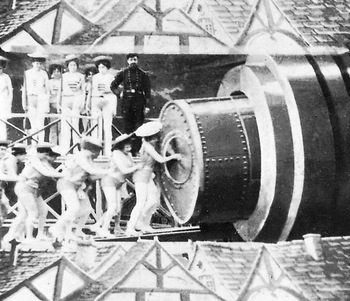
Now she shows stills from early silent films such as George Melies' "A Voyage to the Moon" (1902), which were "as simplistic." Patently, I'k hopelessly handicapped because of my love of cinema, just Melies seems to me vastly more advanced than her 3 modern video games. He has limited technical resources, but superior artistry and imagination.
These days, she says, "grown-upward gamers" hope for games that reach higher levels of "joy, or of ecstasy....catharsis." These games (which she believes are already being made) "are being rewarded by audiences by high sales figures." The only way I could experience joy or ecstasy from her games would be through profit participation.
The three games she chooses as examples do non raise my hopes for a video game that volition deserve my attention long plenty to play it. They are, I regret to say, pathetic. I repeat: "No one in or out of the field has always been able to cite a game worthy of comparison with the dandy poets, filmmakers, novelists and poets."

Why are gamers so intensely concerned, anyway, that games be defined as art? Bobby Fischer, Michael Jordan and Dick Butkus never said they idea their games were an art class. Nor did Shi Hua Chen, winner of the $500,000 Globe Series of Mah Jong in 2009. Why aren't gamers content to play their games and just enjoy themselves? They have my blessing, not that they care.
Practise they require validation? In defending their gaming confronting parents, spouses, children, partners, co-workers or other critics, do they want to exist able to look up from the screen and explain, "I'grand studying a great form of art?" Then let them say information technology, if it makes them happy.
I let Sangtiago the last give-and-take. Toward the stop of her presentation, she shows a visual with half dozen circles, which stand for, I gather, the components at present forming for her brave new world of video games equally art. The circles are labeled: Development, Finance, Publishing, Marketing, Didactics, and Executive Management. I rest my case.
Melies' "Le voyage dans la lune (1902)." I recommend muting the audio track.

Roger Ebert
Roger Ebert was the picture show critic of the Chicago Sun-Times from 1967 until his death in 2013. In 1975, he won the Pulitzer Prize for distinguished criticism.
Latest weblog posts


Latest reviews
Comments
Source: https://www.rogerebert.com/roger-ebert/video-games-can-never-be-art
0 Response to "The Art of It Has Nothing to Do With Game of It Quote"
Post a Comment